Easy Tasks · v2.4.0

Keep your Blender scene tidy while you build it

Scene organisation, mesh cleanup and modelling analysis — one keystroke away. Built for environment and prop work, for Blender 3.0 – 5.x.

35
Tools
11
Categories
3.0–5.x
Blender
$0
GPL-3.0

Free and open source, GPL-3.0-or-later · No licence to buy, nothing held back

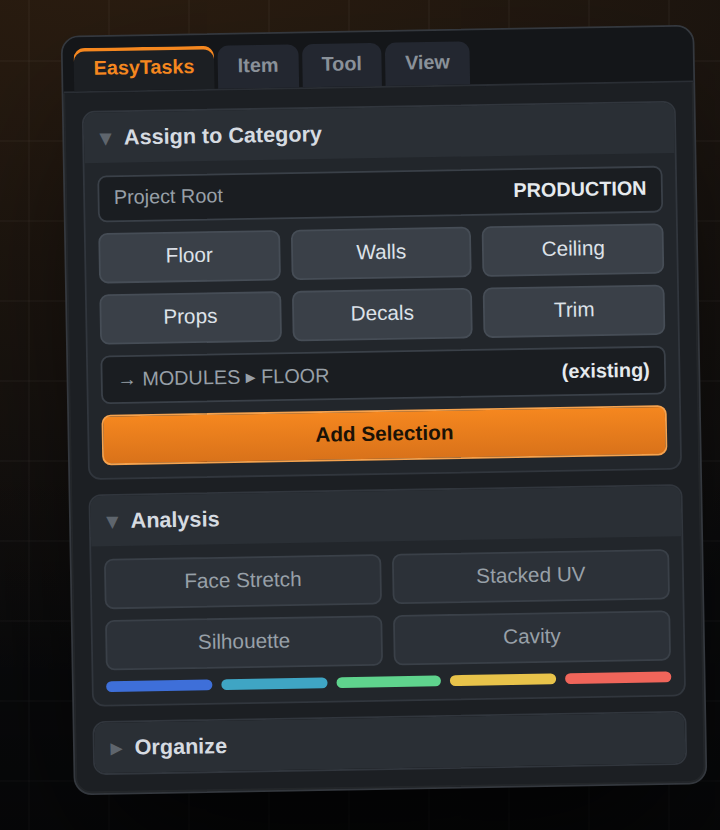
The Easy Tasks sidebar panel in Blender, showing Assign to Category, Analysis and Organize sections.

Blender's outliner will hold any structure you want. It just won't build it for you, and it won't keep it once you're three hours into blocking out a level. Easy Tasks does both — and while it's there, it checks your UVs, reads your silhouettes, and batches your assets out.

One click, per collection

Blender Scene Organization Add-on — Easy Tasks · Plays on YouTube

Thirty-five tools.
Eight that don't exist anywhere else.

It's worth being straight about which is which. The first six below have no built-in equivalent — they're the reason to install it. The last three are Blender work you already do, in one step instead of six.

01Organise

Assign to Category

Select the floor meshes, click Floor. Point it at a project root and it uses the hierarchy you already have, instead of inventing one beside it.

02Organise

Arrange Scene & Auto-route

Sorts every object into matching collections by type and name. Auto-route does it the moment you create something new.

03Organise

Right-click ▸ Add to Collection

In the viewport and the outliner. Suggests a destination, lists existing collections with object counts, searches past twenty.

04Analyse

Face Stretch Analyzer

Colour-codes UV distortion as vertex colours right in the viewport: blue compressed, green even, red stretched. Run it again to restore.

05Analyse

Stacked UV Detector

Finds and selects objects sharing an identical UV layout, so duplicated or stacked UVs surface before they reach a bake.

06Analyse

Silhouette & Cavity

One click each, per-viewport, mutually exclusive — and they restore precisely the shading you had before.

07Produce

Batch Export

Every selected object to its own FBX, OBJ or GLB, with optional prefix/suffix renaming and transform apply.

08Produce

Project Structure & LODs

Build a PRODUCTION ▸ STUDIO / MODULES / BLOCKING tree, and generate Decimate-reduced LOD copies in one step.

09Produce

Cleanup & Color Sync

Consolidate materials, clean up loose geometry, origin to base, and push collection colour tags down onto object viewport colours.

Not in the grid, but in the add-on: Visibility Bookmarks — snapshot which collections are visible under a name, then restore that state later. It's the eighth of the distinctive tools; it just didn't fit the nine-card layout.

Things Blender can do,
but not in one step

Batch Export — each selected object to its own FBX / OBJ / GLB, with optional prefix/suffix renaming and transform apply.
Project Structure — build a PRODUCTION ▸ STUDIO / MODULES / BLOCKING hierarchy, picking which collections you want.
Generate LODs — Decimate-reduced copies into an LODs collection.
Consolidate Materials — merge Mat.001 / Mat.002 back into Mat.
Origin to Base — origin to the bottom centre of the bounding box.
Smart Duplicate — copies stay in their original collection.
Clean Up Mesh — loose vertices and edges, optionally weld doubles.
WNormals + Bevel — bevel, weighted normals and shade smooth in one.
Scene Snapshot — timestamped copy of the .blend into snapshots/.
Scene and Collection Statistics.
Three keys,
everything reachable

CtrlShiftX
Easy Tasks pie
Overlays, collections, transforms, setup
Q
FavTools menu
The full tool list
ShiftAltX
Interaction mode pie
Object / edit / sculpt · vert / edge / face
Rebindable
All three, in Preferences
Scoped to the 3D View keymap, so nothing gets shadowed in your other editors

Beyond those, there's one-key access to things Blender already does — modifiers, UV seams and sharp edges, asset marking, link/transfer data, origin modes, interaction modes, apply transform, shading, select by type, and isolate / swap / select / rename by collection.

Three steps,
about a minute

  1. Download easy_tasks_2.4.0.zip.
  2. In Blender: Edit ▸ Preferences ▸ Add-ons ▸ Install…, pick the zip.
  3. Tick Easy Tasks to enable it.

Install the zip, not the source folder. Blender takes the module name from the folder inside the archive, and the add-on's preferences are keyed to it.

easy_tasks_2.4.0.zip 30 KB · single module

Version 2.3 rewrote the slow paths

Measured on a 160k-polygon mesh and a 1,200-object scene.

Face stretch — write vertex colours
0.9 ms
was 1037 ms
Stacked UV — build signature
25 ms
was 980 ms
Face stretch — compute colours
127 ms
was 808 ms
Arrange Scene — match all objects
1.8 ms
was 18 ms

The auto-route handler used to rebuild a full set of scene object names on every depsgraph update. It now gates on an integer comparison, so its idle cost doesn't scale with scene size.

GPL-3.0-or-later

Free, and staying that way

Use it, modify it, ship commercial work with it — there's no licence to buy and nothing held back for a paid tier. The source is on GitHub. If it saves you time and you'd like to support the work, everything else I make is at 3dartstuff.com.

FAQ

Which Blender versions are supported?

Blender 3.0 through 5.x. It's a single Python module — EasyTasks/__init__.py — with no external packages to install.

How do I install it?

In Blender, open Edit ▸ Preferences ▸ Add-ons ▸ Install…, pick easy_tasks_2.4.0.zip, then tick Easy Tasks. Tools appear in the EasyTasks tab of the 3D viewport sidebar (N), and on the shortcuts above. Install the zip itself — don't unzip it first.

Is it really free?

Yes — GPL-3.0-or-later. Use it, modify it, ship commercial work with it. There's no licence to buy and nothing held back for a paid tier. You can name a price if you'd like to support the work, but $0 is a perfectly good price.

Do the shortcuts clash with my existing keymap?

All three are bound in the 3D View keymap, so they don't shadow keys in other editors. If they collide with your own setup, every one of them is rebindable in Preferences ▸ Add-ons ▸ Easy Tasks.

Where do I report bugs or request features?

Open an issue on the Easy Tasks GitHub repository — it's the fastest way to reach me.